Early math skills begin developing much earlier than formal mathematics lessons. For preschool children, learning numbers does not have to mean sitting with worksheets or memorising number sequences. Simple games, movement, toys, stories, and everyday activities can make counting enjoyable while helping children understand numbers naturally.
Counting activities can help preschoolers develop number recognition, one-to-one correspondence, basic problem-solving skills, and an understanding of quantities. When children learn through hands-on activities, they can explore mathematical concepts in a fun and engaging way.
Why Are Early Math Skills Important?
Early mathematical development provides a foundation for future learning. Preschoolers gradually begin to understand concepts such as numbers, quantities, patterns, comparisons, and simple addition and subtraction.
Regular counting activities can help children:
- Recognise and name numbers
- Count objects accurately
- Understand the relationship between numbers and quantities
- Develop concentration and memory
- Identify simple patterns
- Compare more and less
- Develop early problem-solving skills
- Become comfortable with mathematical concepts
The goal at the preschool stage is not to make children solve complicated calculations. Instead, it is about creating positive and enjoyable experiences with numbers.
Fun Counting Activities for Preschoolers
1. Count Everyday Objects
Use objects that children see every day, such as pencils, blocks, toys, or crayons. Ask your child to count how many objects are present.
For example, place five blocks in front of the child and encourage them to touch each block while saying the numbers aloud.
This simple activity helps children connect number words with actual quantities.
2. Count While Climbing Stairs
Turn everyday movement into a counting game. Encourage children to count each step as they climb the stairs.
You can also count steps while walking, jumping, or doing simple exercises.
Combining physical movement with numbers can make counting more memorable and engaging.
3. Number Hunt
Write numbers on small cards and place them around a safe play area. Ask children to find a particular number.
For example:
“Can you find number 4?”
Once they find it, ask them to collect four objects or do four jumps.
This combines number recognition with quantity and movement.
4. Counting with Building Blocks
Building blocks are excellent tools for early math learning. Ask children to create towers using a specific number of blocks.
Try questions such as:
- Can you make a tower with 3 blocks?
- Can you add one more block?
- Which tower has more blocks?
- Which tower is shorter?
Children can begin understanding counting, comparison, and simple addition through play.
5. Count Fruits and Snacks
Mealtime can become an opportunity for learning. Give children a small number of safe food items and ask them to count them.
For example:
“How many banana slices are on your plate?”
You can then introduce simple concepts such as more, less, one more, and one less.
6. Counting Songs and Rhymes
Songs and rhymes can make numbers easier for young children to remember. Counting songs that involve actions, such as clapping, jumping, or showing fingers, encourage children to participate actively.
Repeating number sequences through songs can also support memory and number recognition.
7. Count and Sort Toys
Ask children to separate their toys into different groups and count each group.
For example, they could create groups of:
- Cars
- Dolls
- Blocks
- Animals
After counting, ask which group has the most or fewest toys.
This activity introduces both counting and classification in a playful way.
8. Number and Object Matching
Create cards with numbers from 1 to 10. Give children small objects such as buttons, blocks, or counters.
Ask them to place the correct number of objects next to each card.
For example:
3 → 🧱 🧱 🧱
This helps children understand that the written number represents a specific quantity.
9. Count During Outdoor Play
Outdoor activities provide many opportunities to practise counting. Children can count flowers, leaves, stones, swings, balls, or steps.
You can also turn outdoor games into simple challenges:
“Can you throw the ball five times?”
“Can you jump ten times?”
These activities connect mathematics with physical play.
10. Simple Counting Stories
Create short stories involving numbers.
For example:
“Three little birds were sitting on a tree. Two more birds came. How many birds are there now?”
Use toys, drawings, or fingers to demonstrate the story.
This introduces children to the idea of addition without making it feel like a formal maths lesson.
How Parents Can Make Counting More Effective
Children learn at different speeds, so counting activities should remain relaxed and enjoyable. Parents can support learning by using numbers naturally during everyday routines.
Instead of asking children to memorise numbers repeatedly, try questions such as:
- How many shoes do you have?
- How many apples are in the basket?
- Can you give me three blocks?
- Which plate has more grapes?
- What number comes after five?
Praise effort and participation rather than focusing only on correct answers.
How Preschool Supports Early Math Learning
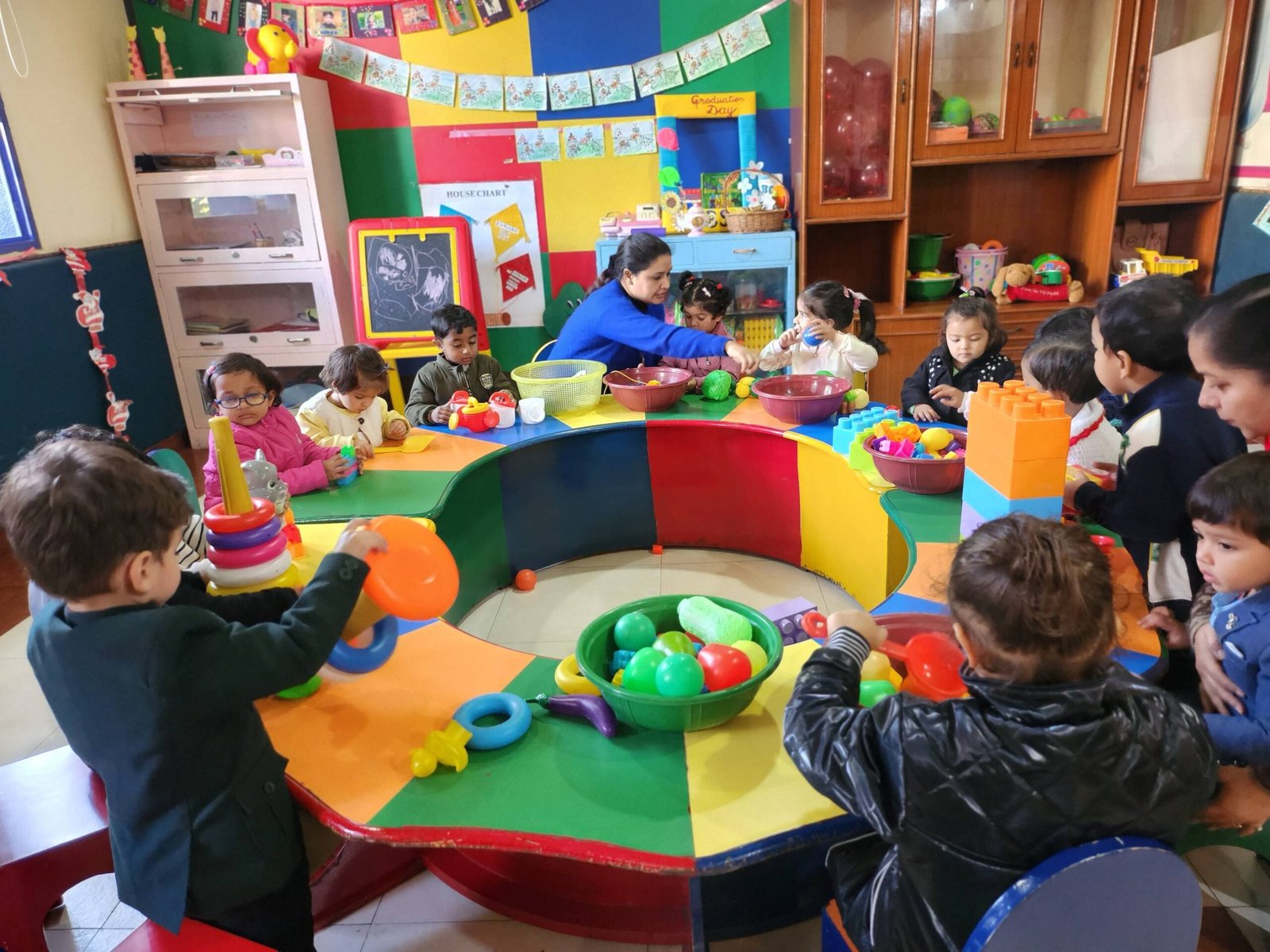
A good preschool environment gives children opportunities to explore mathematical concepts through games, activities, stories, art, movement, and hands-on learning.
At Tinkerbelle, children can experience early learning through age-appropriate activities that encourage curiosity, participation, creativity, and exploration. Counting can be incorporated naturally into classroom routines and play-based activities, helping children become familiar with numbers while enjoying the learning process.
Final Thoughts
Early math learning does not need to be complicated. Counting toys, climbing stairs, sorting objects, singing number songs, and playing simple games can all help preschoolers develop foundational mathematical skills.
The most important thing is to make learning interactive, practical, and fun. When children associate numbers with enjoyable experiences, they can gradually develop confidence and curiosity toward mathematics.