Kindergarten is an important stage in a child’s early education. At this age, children learn best when they are actively involved, curious, and having fun. Instead of relying only on traditional classroom instruction, teachers and parents can introduce different activities for kindergarten children that combine learning with play.
From creative art projects and storytelling to number games, music, outdoor play, and hands-on experiments, the right activities can help children develop communication, creativity, coordination, problem-solving abilities, and social skills.
If you are looking for unique activities for kindergarten children, here are 30 simple and engaging ideas that can make everyday learning more enjoyable.
Why Are Activities Important for Kindergarten Children?
Activities give young children an opportunity to learn by doing. They can make difficult concepts easier to understand while allowing children to explore their surroundings and express themselves.
Well-planned kindergarten activities can help children:
- Develop creativity and imagination
- Improve communication and language skills
- Strengthen fine and gross motor skills
- Learn numbers, letters, shapes, and colours
- Develop problem-solving abilities
- Build confidence and independence
- Learn how to cooperate with others
- Improve concentration and listening skills
- Develop social and emotional skills
- Become more interested in learning
The key is to select fun activities for kindergarten that are appropriate for children’s age and abilities.
30 Fun and Unique Activities for Kindergarten
1. Colour Sorting Activity
Give children objects in different colours and ask them to sort them into groups. You can use blocks, paper pieces, toys, buttons, or classroom objects.
This simple activity helps children recognise colours while developing their observation and classification skills.
2. Number Hunt
Hide numbers around the classroom and ask children to find them. Once they discover a number, they can say it aloud or match it with the correct quantity of objects.
It is a fun way to introduce numbers and counting.
3. Storytelling Circle
Ask children to sit in a circle while the teacher tells a short story. You can also allow children to create their own endings or describe what they think will happen next.
Storytelling supports vocabulary, listening, imagination, and communication skills.
4. Shape Matching Game
Prepare cards showing circles, squares, triangles, rectangles, and other basic shapes. Children can match the shapes with objects around the classroom.
For example, a clock can be matched with a circle and a book with a rectangle.
5. Letter Hunt
Place alphabet letters around the classroom and ask children to find specific letters. You can make the activity more interesting by asking them to find the first letter of their name.
This helps children become familiar with the alphabet in an enjoyable way.
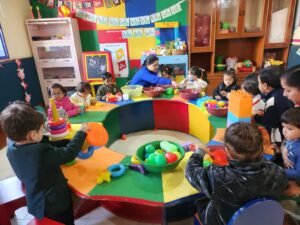
6. Building Block Challenge
Give children building blocks and ask them to create a house, tower, bridge, or any structure they can imagine.
Building activities encourage creativity, coordination, planning, and problem-solving.
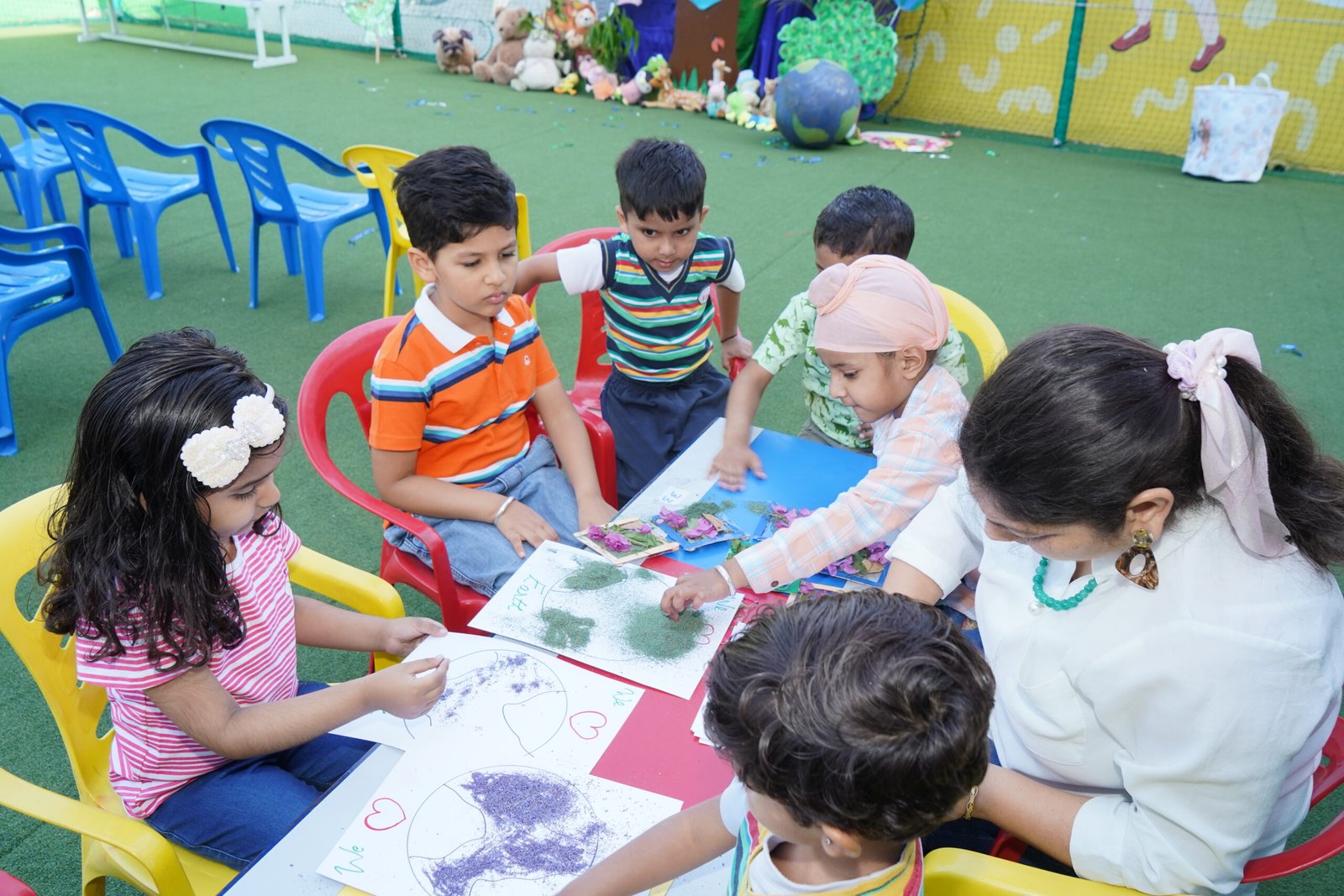
7. Nature Collection Activity
Take children outdoors and ask them to collect safe natural objects such as leaves, small twigs, or fallen flowers.
Afterward, they can sort the objects according to colour, size, or shape.
8. Role-Play Activity
Create simple role-playing situations such as a doctor’s clinic, grocery store, classroom, restaurant, or post office.
Role-play allows children to use their imagination while developing communication and social skills.
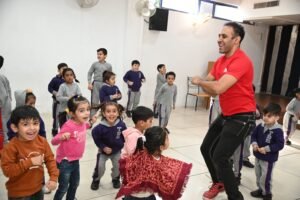
9. Musical Movement Game
Play an age-appropriate song and encourage children to move, clap, jump, or dance according to the rhythm.
Music and movement activities can support coordination, listening, rhythm, and physical development.
10. Memory Matching Game
Create pairs of cards containing pictures, letters, numbers, or shapes. Place them face down and let children turn over two cards at a time to find matching pairs.
This activity encourages memory, concentration, and visual recognition.
11. Clay Modelling
Give children child-safe modelling clay and encourage them to create animals, fruits, flowers, shapes, or imaginary characters.
Clay modelling is an excellent activity for strengthening hand and finger muscles while encouraging creativity.
12. Picture Story Sequencing
Give children three or four pictures showing events in a simple story. Ask them to arrange the pictures in the correct order.
This helps children understand sequencing and encourages them to explain their ideas.
13. Treasure Hunt
Create a simple classroom treasure hunt using clues based on colours, shapes, numbers, or objects.
For example, you could ask children to find something red or locate an object shaped like a circle.
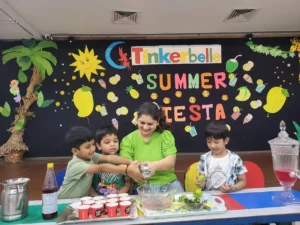
14. Water Play
Provide a supervised water-play activity using cups, containers, funnels, and floating objects.
Children can explore concepts such as full and empty, floating and sinking, and more and less.
15. Puppet Show
Use simple puppets to tell a short story or encourage children to create their own puppet conversation.
Puppet activities can make storytelling more interactive while helping children express themselves.
16. Counting Objects
Give children everyday classroom objects and ask them to count them. You can use pencils, blocks, balls, or toy animals.
This provides a hands-on way to practise basic counting skills.
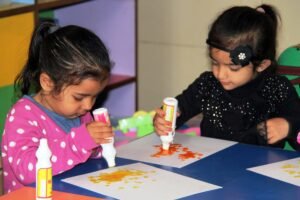
17. Drawing and Colouring
Give children a theme such as “My Family,” “My Favourite Animal,” or “A Rainy Day” and let them draw and colour freely.
Creative activities allow children to express their ideas while improving hand-eye coordination.
18. Puzzle Challenge
Introduce age-appropriate puzzles with pictures, shapes, animals, or numbers.
Puzzles encourage children to observe details, think logically, and find solutions.
19. Indoor Obstacle Course
Create a simple obstacle course using safe classroom materials. Children can walk around cones, crawl under a table, jump over soft objects, or follow a marked path.
This can support balance, coordination, and gross motor development.
20. Animal Sound Game
Show children pictures of different animals and ask them to identify the animal and imitate its sound.
You can also make it a guessing game where children identify an animal based only on its sound.
21. Shape Creation Activity
Give children sticks, craft materials, or building pieces and ask them to create different shapes.
This makes learning geometry more hands-on and engaging.
22. Alphabet Matching
Prepare uppercase and lowercase alphabet cards. Ask children to match the corresponding letters.
You can also add pictures to help children connect letters with familiar words.
23. DIY Musical Instruments
Use safe recycled materials to create simple instruments such as shakers or drums.
Children can then use their instruments during a classroom music session.
24. Sorting and Grouping Activity
Give children different objects and ask them to group them based on characteristics such as size, colour, shape, or type.
This activity introduces early classification and logical thinking.
25. Gardening Activity
Let children participate in a simple supervised gardening activity. They can plant seeds, water plants, or observe how plants grow.
Gardening can introduce children to nature and basic environmental concepts.
26. Freeze Dance
Play music while children dance. When the music stops, everyone has to freeze.
This activity is simple but effective for developing listening skills, body control, and coordination.
27. Simple Science Experiment
Introduce a safe and age-appropriate experiment, such as observing what happens when different objects are placed in water.
The goal is not complicated scientific theory but encouraging children to ask questions, make observations, and share what they discover.
28. Emotion Recognition Game
Show pictures representing different emotions such as happiness, sadness, anger, surprise, or fear. Ask children to identify the emotion and explain when they might feel that way.
This can help develop emotional awareness and communication.
29. Team Building Activity
Divide children into small groups and give them a simple collaborative challenge, such as building the tallest block tower together.
Team-based activities teach children how to share, communicate, cooperate, and work toward a common goal.
30. Show and Tell
Ask each child to bring or select a familiar object and talk about it in front of the class.
Show and tell is a simple but powerful activity for building confidence, vocabulary, listening skills, and public speaking abilities.
How Do These Activities Support Kindergarten Learning?
The best kindergarten activities are not simply designed to keep children busy. They should have a learning purpose.
For example, sorting activities can introduce early mathematical thinking, storytelling can strengthen language skills, building blocks can encourage problem-solving, and group games can develop social skills.
Combining different types of activities throughout the week allows children to learn through multiple approaches.
How Parents Can Continue Kindergarten Activities at Home
Learning does not have to stop when children leave school. Parents can introduce simple activities at home using everyday objects.
Some easy ideas include:
- Counting toys together
- Reading a story before bedtime
- Sorting clothes by colour
- Drawing and colouring
- Making shapes using household materials
- Playing memory games
- Gardening together
- Creating simple crafts
- Singing songs and rhymes
- Encouraging children to describe their day
Parents do not need expensive educational toys to make learning enjoyable. Everyday experiences can become meaningful learning opportunities when children are encouraged to explore and ask questions.
Why Unique Activities Make Learning More Engaging
Children naturally learn through exploration. When they are given opportunities to touch, move, create, observe, communicate, and experiment, learning can become more memorable.
That is why incorporating unique activities for kindergarten into the learning environment can help create a classroom where children are encouraged to participate rather than simply listen.
A balanced kindergarten programme can combine academic concepts with creative activities, physical movement, social interaction, and play-based learning.
Final Thoughts
Kindergarten is about much more than learning letters and numbers. It is a stage where children begin developing the foundational skills they will use throughout their education.
By introducing a variety of activities for kindergarten, teachers and parents can make learning more interactive, enjoyable, and meaningful. Whether it is storytelling, art, outdoor exploration, puzzles, role-play, music, or simple science experiments, every activity can become an opportunity to learn.
At Tinkerbelle, a child-friendly learning environment can help children explore concepts through age-appropriate activities while developing confidence, creativity, communication, and essential early-learning skills.
The right combination of play and learning can make the kindergarten experience engaging, positive, and memorable for every child.
Frequently Asked Questions
What are some good activities for kindergarten children?
Some good activities for kindergarten children include storytelling, drawing, colouring, number games, alphabet games, puzzles, building blocks, role-play, music and movement, sensory play, nature activities, and simple science experiments. Activities should be age-appropriate and designed to encourage participation and learning.
What are unique activities for kindergarten?
Unique activities for kindergarten can include treasure hunts, puppet shows, picture sequencing, DIY musical instruments, emotion recognition games, nature collections, building challenges, simple science experiments, and classroom role-play. These activities combine creativity and learning while keeping children engaged.
How do activities help kindergarten children learn?
Activities allow children to learn through hands-on experiences. They can help develop communication, creativity, concentration, coordination, problem-solving, early mathematical thinking, social skills, and emotional awareness.
What activities can kindergarten children do at home?
Children can participate in simple activities at home such as reading stories, counting toys, drawing, colouring, sorting objects, making crafts, playing memory games, gardening, singing songs, and creating shapes using safe household materials.
Why is play-based learning important in kindergarten?
Play-based learning gives children opportunities to explore ideas naturally while developing important academic, physical, social, and emotional skills. It can make learning more enjoyable and encourage children to participate actively in the learning process.